
Tait base stations, read over SNMP
Tait exposes the base station over SNMP. Davicom reads it, then puts the rest of the site next to it: the power plant, the environment, the timing and the antenna.

One simulcast site . deployment in service
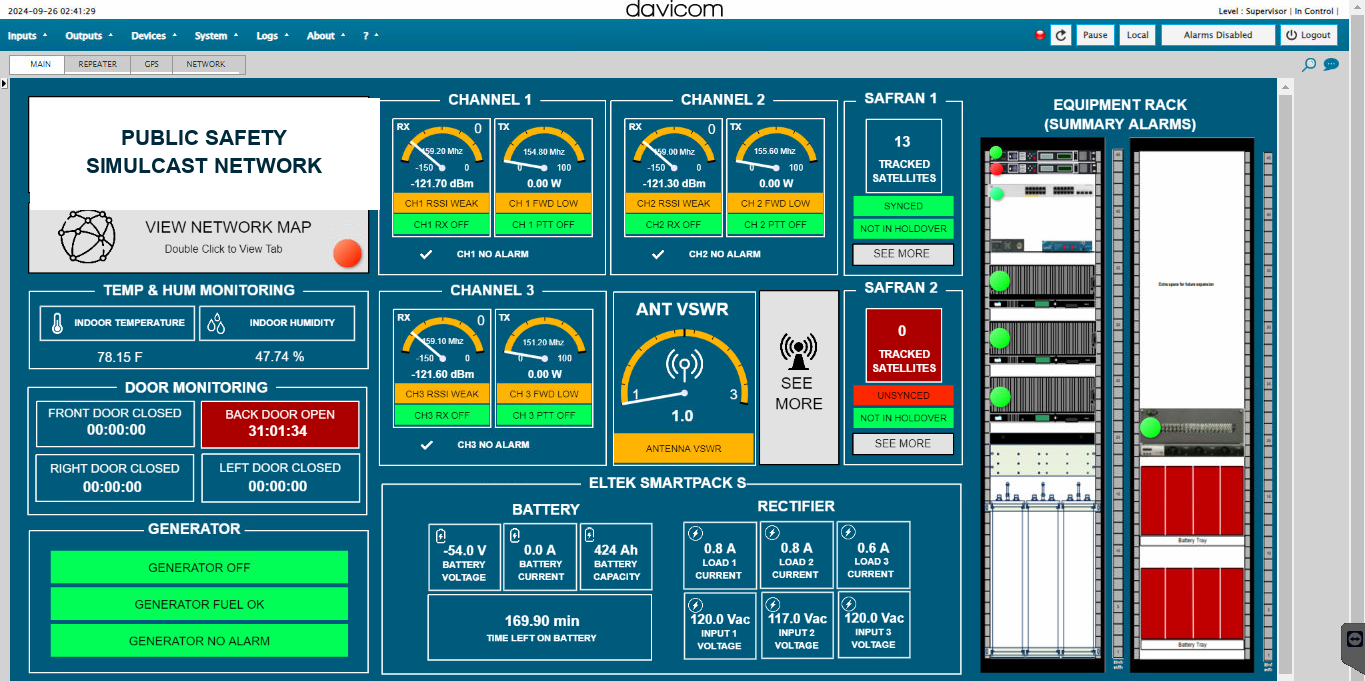
The summary page of a Tait simulcast site: the three channels and the antenna VSWR at the centre, the GPS receivers beside them, the DC plant along the bottom, and doors, generator, temperature and humidity down the left. Deployment shown with the operator identity removed.
The short answer
How do you monitor a Tait simulcast site?
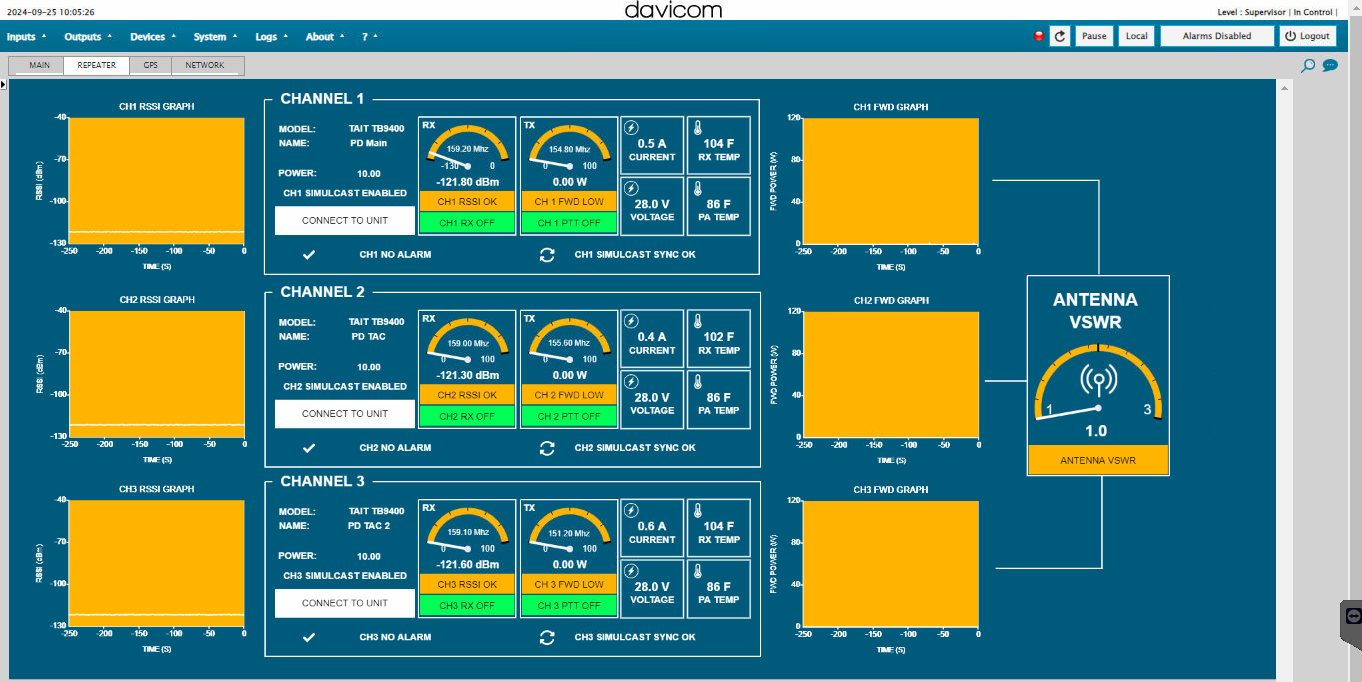
Tait publishes the base station over SNMP, and a Davicom CORTEX polls that interface directly. Per channel it reads the repeater model and name, receive level in dBm, transmit power in watts, supply current and voltage, receiver and power amplifier temperature, and the simulcast sync state, as values rather than as bare alarms, so each one carries a threshold and a trend. The same unit adds what the base station cannot see: antenna VSWR, GPS satellites tracked and holdover state, the DC plant and its remaining autonomy, generator, doors, temperature and humidity. Interconnection is through GPIO or SNMP.
What the base station publishes
Tait base station
- Repeater model and name
- Receive leveldBm
- Transmit powerW
- Supply current and voltage
- Receiver temperature
- Power amplifier temperature
- Simulcast sync state
There is nothing to interpose and nothing to wire for it.
What the base station cannot see
- GPS receivers and timingSNMP
- Voting systemSNMP
- DC plant and rectifiersSNMP
- Generator state and fuelGPIO
- Doors, temperature and humidityGPIO

Davicom CORTEX
One per site. It keeps reading its own base station and its own plant, backhaul or not.
- Receiver in holdover
- Silent failover
- Time left on battery
 Several sites acting as one, on a single map, with every alarm in one list and its site named.
- Read over SNMPThe base station's own interface, polled by the unit at the site. No extra box in the chain.
- Per channel, not per siteEach channel carries its own model, name, levels, temperatures and sync state.
- Values, so thresholdsReceive level and forward power are numbers, so a slow degradation becomes visible instead of arriving as a failure.
- Simulcast syncThe sync state of each channel, named rather than guessed at.
- GPS and holdoverSatellites tracked, synchronisation state, and whether a unit has fallen into holdover. A receiver in holdover is still working, for now, and that is exactly the window in which someone should be told.
- The DC plant, in operator termsBattery voltage and current, remaining capacity, estimated time left on battery, load current on each rectifier output, and the AC input voltage of each phase.
The whole base station is readable, so we read all of it
The interesting part of a Tait site is that the base station already publishes its own state over SNMP. There is nothing to interpose and nothing to wire for it. The Davicom CORTEX polls that interface and takes what the station exposes.
In service that means, per channel: the repeater model and name, receive level in dBm, transmit power in watts, supply current and voltage, receiver and power amplifier temperature, and the simulcast sync state. Values, not just alarms, so each one can carry a threshold and a trend.
On a simulcast network, timing is the network
The GPS receivers are monitored the way the site depends on them: satellites tracked, synchronisation state, and whether a unit has fallen into holdover. A receiver in holdover is still working, for now, and that is exactly the window in which someone should be told.
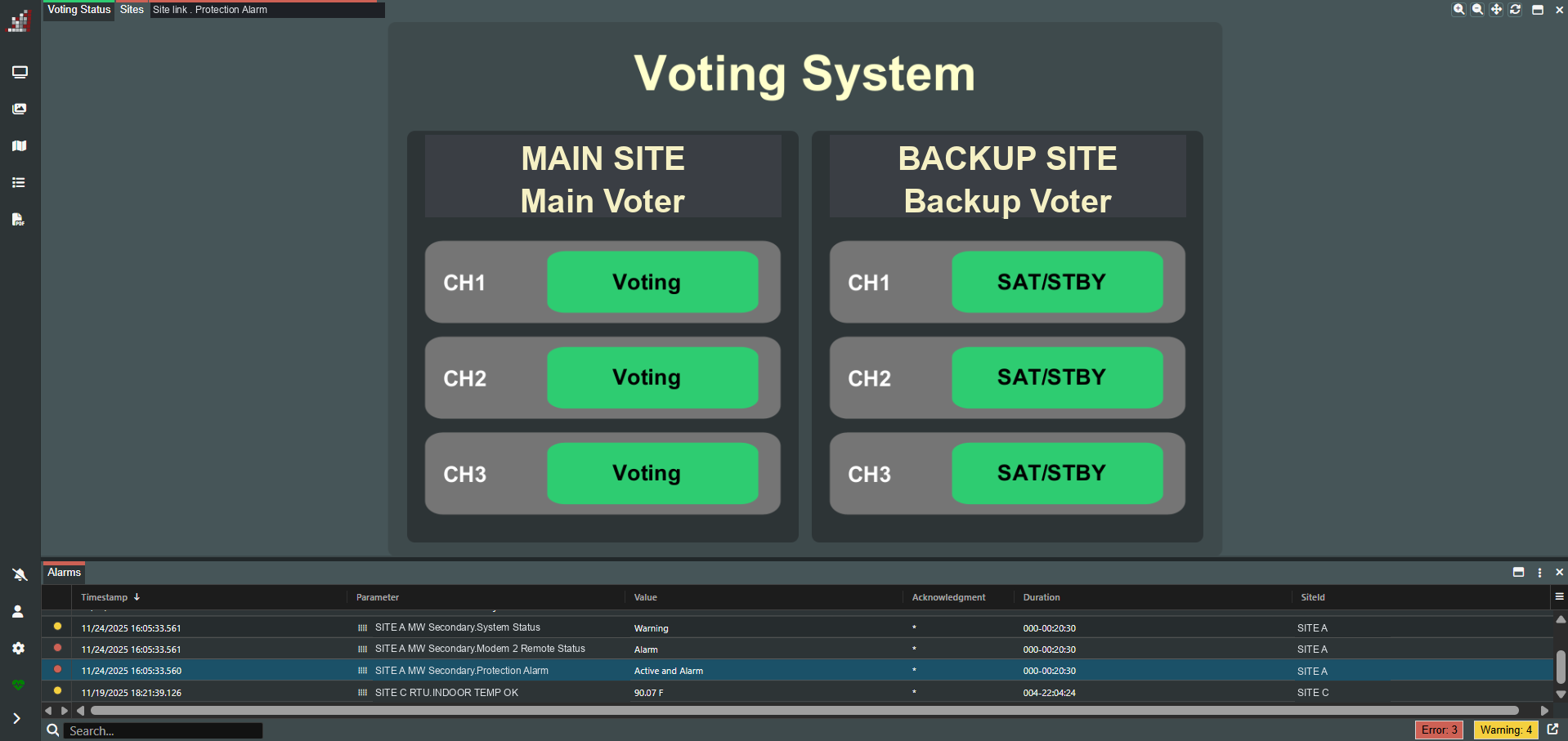
The voting system is watched the same way. Each channel shows which voter is carrying it and which one is standing by, so a silent failover is a line on a screen instead of a surprise during the next incident.
A radio that is fine on a site that is not is still an outage waiting
The same unit carries what the base station cannot see. The DC plant is read in the terms an operator uses: battery voltage and current, remaining capacity, estimated time left on battery, load current on each rectifier output, and the AC input voltage of each phase. Generator state and fuel sit beside them, with doors, indoor temperature and humidity, and the antenna VSWR.
Interconnection is through GPIO or SNMP, so equipment that publishes an interface is polled and equipment that does not is wired. Either way it lands in the same view as the radios.
When there is more than one site, the alarms come together in Mosaic
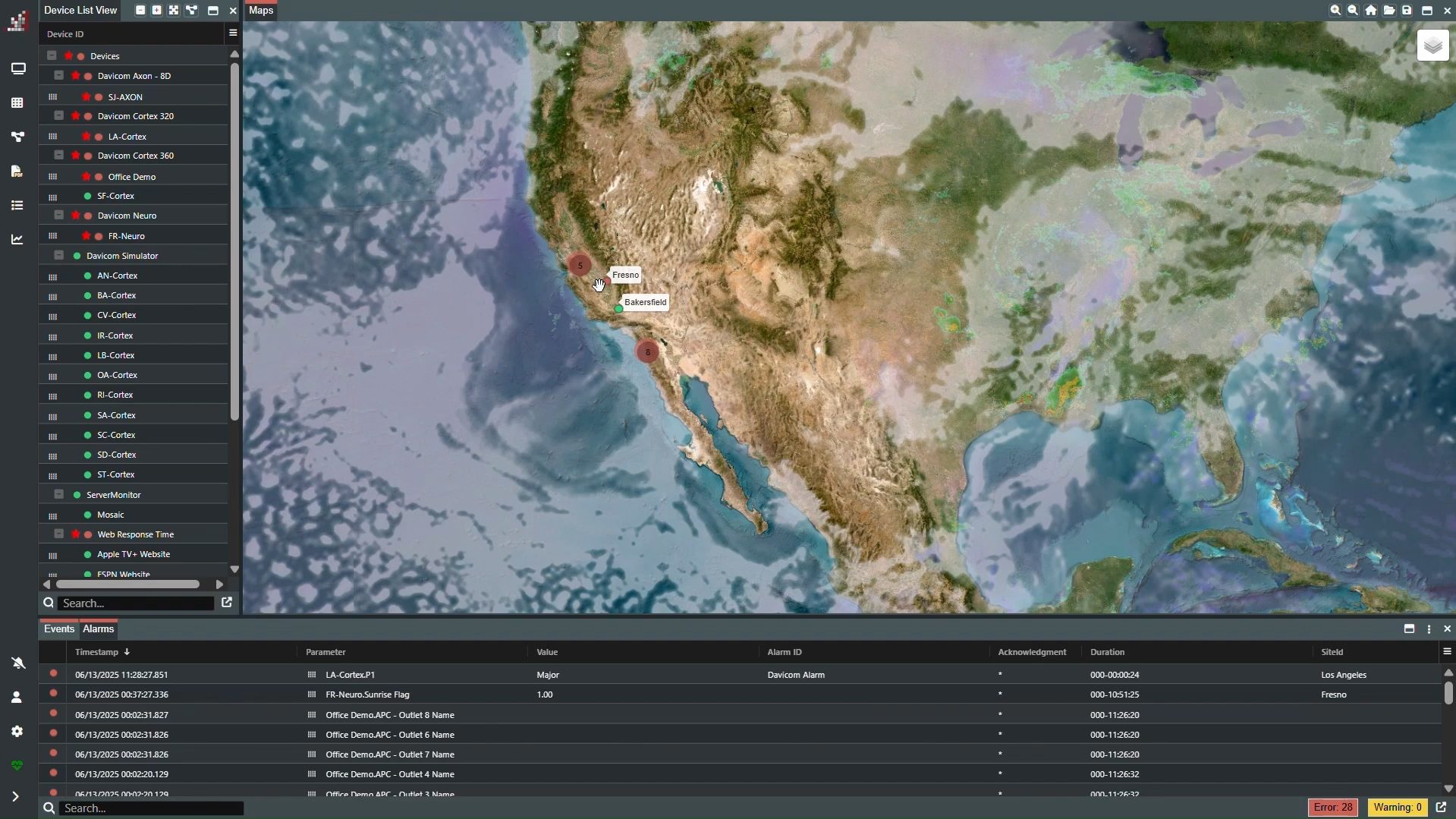
A simulcast network is several sites acting as one, which is exactly the case where looking at sites one at a time falls apart. Mosaic puts them on a single map, with every alarm in one list and its site named.
Each Davicom CORTEX keeps reading its own base station and its own plant, backhaul or not. Mosaic is the layer above, for the operator who needs to know which of the sites is the one drifting.
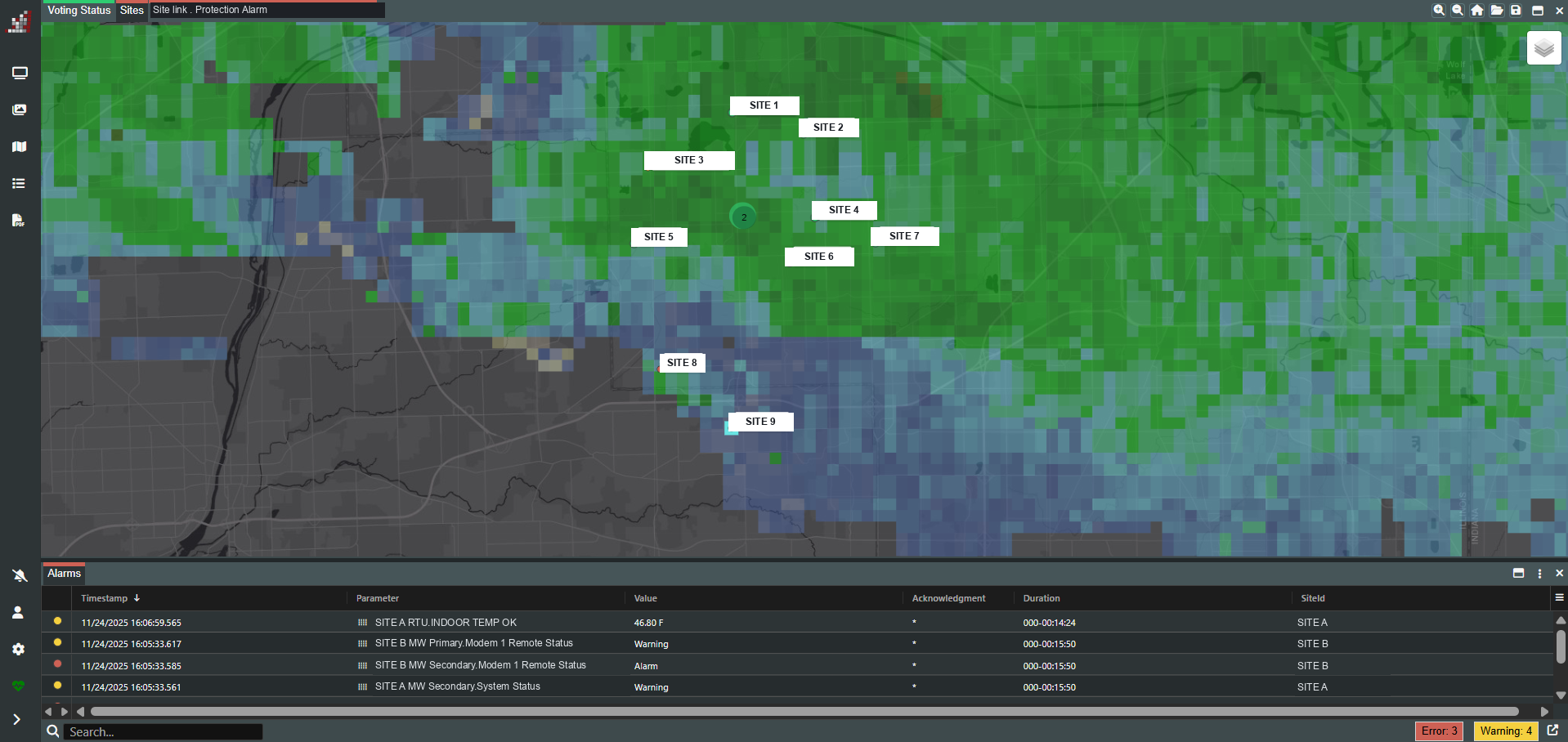


Sites of one network on a single map, the alarm list that gathers them, and the history behind any one of their readings. Network in service, site identities removed.
Every site, each carrying its own alarm count, with history behind it.
The site, the equipment and the parameter named on the same line.
What the units read and what other systems send, normalised in one console.
Each unit keeps its own thresholds and automation. The console consolidates, it does not decide.
A GPS receiver in holdover is still serving the network. That is precisely the window in which someone should be told, and precisely the window nobody watches.
Questions we get asked
Does Davicom support the Tait SNMP interface?
Yes. The Davicom CORTEX polls the base station over its own SNMP interface and reads what the station publishes, per channel: model and name, receive level, transmit power, supply current and voltage, receiver and power amplifier temperature, and simulcast sync state. Values come back as numbers, so each one can carry a threshold, an alarm and a trend.
What can be read from a Tait base station?
In service today: per channel model and name, receive level in dBm, transmit power in watts, supply current and voltage, receiver temperature, power amplifier temperature and simulcast sync state. The site adds antenna VSWR, GPS satellites tracked and holdover state, DC plant and battery autonomy, generator, doors, temperature and humidity.
What is monitored for GPS and timing on a simulcast site?
Satellites tracked, synchronisation state and holdover state for each GPS receiver on site. Holdover is reported as its own condition, because a receiver in holdover is still serving the network while its margin runs out.
Is the voting system monitored as well?
Yes. The voting status page shows, channel by channel, which voter is carrying the channel and which is standing by, so a failover between main and backup is visible when it happens rather than discovered later.
What does the DC plant view show?
Battery voltage, battery current, remaining capacity, estimated time left on battery, the load current of each rectifier output and the AC input voltage of each phase, with generator state and fuel alongside.
Can several Tait sites be watched from one console?
Yes. Mosaic gathers every site into one view: a map with each site and its alarm count, and a single alarm list naming the site, the equipment and the parameter. On a simulcast network, where several sites act as one, that is what turns an alarm into an address.
Other proven integrations
 Kenwood NEXEDGEKenwood NEXEDGE site monitoring
 EF Johnson ATLAS P25EF Johnson ATLAS P25 site monitoring
Interconnection is possible through GPIO or SNMP, so equipment outside this list is monitored the same way. Tell us the model and we come back with the answer.
Need help, or ready to purchase?
Call us
1 877 282-3380Get in Touch
Ready for the next step? Schedule a call or demo with a member of our sales team or quickly and easily request a quote.
Get startedSupport Portal
Find solutions and useful resources like articles, downloadable datasheets, manuals, software, workspaces and more.
See moreFind a Dealer
Find a Davicom authorized dealer. Our dealer locator provides the most up-to-date information on dealers close to you.
Find a dealer